
Leonardo’s Annunciation—A Closer Look
- Denise Laurin
- Nov 24, 2025
- 2 min read


With the Christmas season upon us, taking time to contemplate Leonardo’s Annunciation seems fitting. In 1472 when he painted the Annunciation, Leonardo would have been only nineteen years old and still in the workshop of Andrea del Verrocchio.
Leonardo was among the first artists to explore the “new” technology of oil painting. Far from being a new medium, oil painting had been around for hundreds of years, but it was Jan van Eyck, a Northern Renaissance painter, who exploited the potential of the medium, developing it into the lustrous, delicately layered technique that makes Renaissance paintings glow with life.
In Leonardo’s envisioning of the Annunciation, we see the Archangel Gabriel kneeling before Mary in a garden strewn with white flowers, offering her a lily, symbolic of her purity.

He has interrupted her while she reads scripture. Leonardo was all about gesture. No wonder! It is an integral component of speaking the Italian language. Mary’s right hand gracefully (and somewhat anatomically impossibly), manages to hold her place in the text. Her left hand is raised in a surprised greeting.
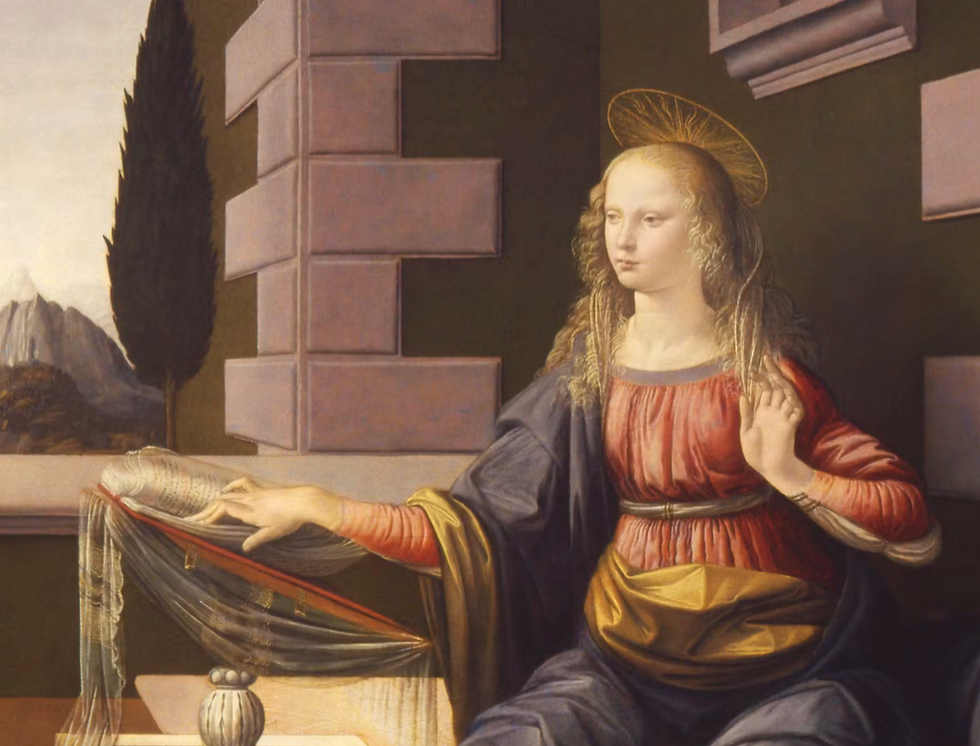
This significant event takes place in the contemporary setting of a Renaissance palazzo, accurately drafted according to the rules of linear perspective developed earlier in the 15thcentury by Brunelleschi. The trees evoke Tuscany rather than Judea, and Leonardo has added fantastical rock formations in the distance, shrouded in the blue haze of atmospheric perspective.

Leonardo’s powers of observation can be seen in the meticulously rendered feathers of Gabriel’s wings, based on his studies of birds. One unusual detail, given that angels are spiritual beings, is the shadow cast by the archangel on the ground next to him, suggesting a solid earthly form. Most likely, this inconsistency with what we assume about angels is due to Leonardo’s copious study of the model from life. Similarly, Mary possesses convincing volume, yet the glowing quality of her skin reveals the inner purity of her soul. Leonardo’s seamless blending, known as sfumato, contributes to the heightened sense of divinity in this painting.

Among my favorite passages in Leonardo’s paintings is his handling of hair and transparent objects. Note the diaphanous fabric under the holy text, as well as the hair under the Virgin’s veil. So delicately rendered! Contrast that quality with the weightiness of the carved stone lectern.


I hope taking a closer look at the Annunciation has slowed your heart rate and made you more aware of the present. Keep this sensation in mind as you walk through the busyness of the coming month ahead.
Written by Denise Laurin, M.A. Art history, www.deniselaurinvisualart.com


Comments